
Can posting a preprint be morally wrong?

Open access is a complicated business. Everytime I think I understand it (and I've blogged a lot on it, trying too get to gripes with it - in particular this post), some new nuance appears to make me realize I don't really understand at all.
In this case, my mind was blown when I learnt that there was wall of shame for posting preprints on Bioarxiv! But let's back up a bit and talk a bit about preprints first.
Preprints are getting important
There are varying definitions of preprint as noted here, But for the purposes of our definition let's just refer to preprints to papers that are the versions before the versions accepted for publication. (aka everything except the accepted version and published version)
First off you might be aware that Crossref has encouraged registering of dois for preprints since November 2016. In fact, growth of doi registration for preprints has been 10 times higher than journal articles. Ross Mounce points out that versioned dois do exist for F1000 as well.
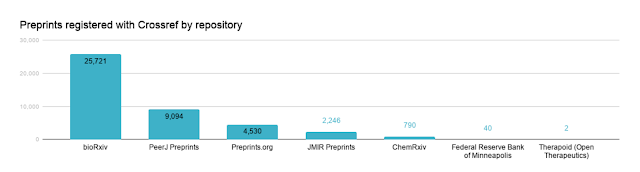
Preprint repositories that register with Crossref
This of course has potential to lead to a proliferation of dois.
Everything form preprints to emphemeral digital objects are being assigned DOIs. In #scholcomms this is often resulting in the minting of a DOI for a preprint, an AAM & a final published version. Not to mention items deposited in 3rd party repositories minting their own DOIs.
— George Macgregor (@g3om4c) July 26, 2018
Macgregor then asks "In other words, do we need a super identifier in which all known referenced manifestations of a work are unified, a bit like the #FRBR model of bibliographic objects where various manifestations of the same work are distinguished but unified."
This is a very important question to ask now that non version of records are increasingly surfaced.
Having a doi for preprints is a first step but how do you know one doi is a preprint version of another doi that is the published version?
It does - we help preprint depositors identify when a final paper has been registered with Crossref, and the preprint registrant adds that relationship to their preprint metadata and also links to the final work from the preprint landing page.
— Crossref (@CrossrefOrg) July 12, 2018
As the tweet about shows if you register a preprint with a doi, you not only get the option to edit your metadata to create a “isPreprintOf” relation type to the accepted version or verison of record. but you are informed that the possibility exists.
In fact Crossref states "Once an item has been published from the posted content, the posted content publisher must update their publication metadata with the AM (Accepted Manuscript) / VOR (version of record) DOI using the “isPreit printOf” relation type." (italics mine)
Is there a requirement to be a link from the other end (from AM/VOR DOI to preprint DOI), I believe not. Not sure about implications of this if the linking mostly comes from the preprint to the AM/VOR.
Where and where should preprints be posted?
So far so good right? But here's where things get confusing
There have been distractions of the preprints before including this recent Nature piece entitled "Preprints could promote confusion and distortion" and questions about indexing
Nothing new, but then I ran into this
Introducing the bioRxiv Wall of Shame.
The Wall: https://t.co/X0Ty6gb8rW
Blog post: https://t.co/Ax2izrRpMQ— Jordan Anaya (@OmnesResNetwork) August 3, 2018
A post was created trying to shame some researchers for posting preprints in Bioarxiv on a "Wall of Shame"! For more information see here, here
If you are like me, your first thought would be "Huh? Why would posting a preprint be a bad thing" But let me qualify.
The proposed "Wall of Shame" was for researchers were only posting preprints after they were accepted for publication in Bioarxiv, which was against their rules.
For example on their FAQ it says
Q: Can I submit an article to bioRxiv that I have submitted to a journal?
A: An article must be submitted to bioRxiv before it is accepted by a journal. If an article has been submitted to a journal but not yet been accepted for publication, it can be submitted to bioRxiv."
Open Access vs Open Science
Even with this qualification , it still sounds bonkers right? To a librarian and any open activist it seems odd that Bioarxiv cares about when the preprint is made open. From the point of view of access, the key point is to made the best version possible (legally allowed) accessible for free and if it happens to be the preprint so be it, and it makes no sense that when you make the preprint available is a point of contention.
But the proposer of the wall of shame is actually looking at it at another point of view.
He writes
"Open science is something that employers are beginning to take into account when hiring. The fact that you can post a bunch of postprints at bioRxiv, then list them on your resume as evidence for your dedication to open science is disgusting. Your preprint should be posted early in the publication process, not after it was accepted, not when it is about to be accepted, and definitely not after it was published. "
He then claims (I think correctly) that while someone might be unlucky and posted a preprint just before it got accepted or is just a misunderstanding of the policy, that it's more likely "authors are waiting for their paper to get accepted, and then, and only then, are posting a preprint as a means to generate interest in their soon-to-be-published paper."
To be fair he is not against posting of preprints and is okay with those papers being posted "on your website, Figshare, or literally anywhere that doesn’t involve you lying about your manuscript not being peer reviewed."
Obviously some people disagree.
But this distinction between posting preprints to speed up scientific communication aka Open science and to support Open Access is a distinction I haven't considered and it's unclear to me how wide spread support for this is.
But it does seem that at very least in Bioarxiv these are two seperate things. Witness this tweet
Did you know this? Seems @biorxivpreprint was not meant to support #openaccess @jeroenbosman @MikeTaylor @Protohedgehog @brembs https://t.co/eno3072X7N
— Pandelis Perakakis (@ppandelis) July 14, 2018
Also further downthread @hvdsomp tweets that "Preprints were never really considered OA because OA proponents are obsessed with the peer reviewed version. Check the Wikipedia page and its history. OA is merely about finding other business models to do the same ol’ thing."
Implications
I've always been confused by the distinction between institutional repositories, preprint repositories and discipline repositories (which are often preprint repositories or some combination of preprint + post print servers). My thinking was if institutional repositories were already archiving the best legal version of journals allowed by journals policies which includes preprints were the rise of preprint servers in competition with Institutional repositories? My thinking was if so, there would be needless deduplication of work.
But with the above discussion, it seems the distinction is clear. If your aim is to speed up dissemination of results, your papers would be on Preprint servers like Bioarxiv.
If you didn't want to do that (perhaps you are worried about getting scooped), then you would wait for the paper to be accepted then post the best allowed versions (which might be a preprint) to the institutonal repository!
What do you think?